
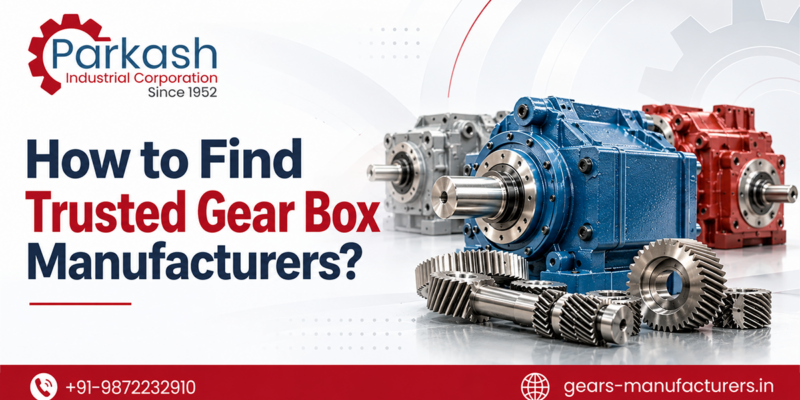
How to Find Trusted Gear Box Manufacturers? A Complete Guide for Buyers
Most buyers don’t think much about their gearbox supplier until a machine stops. Then it’s all anyone talks about. The gearbox sets your speed, carries the power, and decides whether the machine runs quietly for years or complains every shift.
The market is crowded, and honestly, not every gear box manufacturer is worth your time. Price is the first thing people compare, but it’s rarely the thing that hurts later. What hurts is weak material, sloppy machining, or a delivery date that keeps sliding. This applies whether you’re buying for farm equipment, construction machinery, a cement plant, or a general factory line.
So here’s what to check before you commit.
1. Look at Their Experience
Ask how long they’ve been making gears and, more importantly, what they’ve made. A shop that has run many jobs will have seen odd drawings, tough duty cycles, and awkward customer requests. That counts for a lot.
Check whether they’ve worked in your industry. A rotavator gearbox and a cement plant gearbox are not the same job. The loads, shock, dust, and running hours are all different.
A good manufacturer can read your drawing without hand-holding. They’ll also tell you if a material choice looks wrong, or if a different gear arrangement would suit the application better. If they only say “yes, no problem” to everything, be careful.
2. Ask How They Control Quality
A tiny error in tooth profile or gear dimensions doesn’t stay tiny. It shows up as noise, vibration, heat, and gears wearing out long before they should.
So ask them directly how they check their work. Things worth asking about:
- Material: What steel do they use, and where do they source it?
- Dimensions: How do they measure, and at which stages?
- Tooth finishing: Is the profile accurate enough for smooth meshing?
- Inspection: Are parts checked before dispatch, or just packed and sent?
- Fit for the job: Does the design actually match your load, speed, and torque?
Ask for inspection reports or material certificates too. A serious supplier won’t mind. If they get vague or defensive, that tells you something.
3. See How Well They Handle Custom Work
Machines differ. Ratios, mounting, shaft sizes, and torque needs change from one setup to another, and a standard catalogue part often doesn’t fit. This matters most if you build machinery, or if you’re hunting for a replacement part for an old machine that nobody makes anymore.
Say you make agricultural equipment and need a special gearbox for a rotavator. Or you supply construction equipment and need particular gear components for a heavy-duty unit. You need a manufacturer who can work from your drawings or even from a worn sample.
Before you decide, discuss:
- Gearbox types they can build
- Custom sizes and gear ratios
- Materials and heat treatment
- Working from your drawings
- Whether it will fit your existing machine
- Whether they can handle repeat orders without quality slipping
The good ones try to solve your problem. The rest try to sell you what’s already on the shelf.
4. Compare Price, Delivery, and Support
The cheapest quote often has a catch. Usually it’s cheaper steel, looser tolerances, or rushed finishing, and you pay for that later in repairs and downtime.
Look at the whole picture instead: what you’re getting, how long it should last, and who helps you if something goes wrong.
Delivery deserves the same attention. If your gearbox arrives three weeks late, your production line waits three weeks. Get the manufacturing and dispatch timeline in writing before you order.
And notice how they talk to you. Do they answer technical questions properly? Do they update you without being chased? A supplier who is responsive before the order is usually responsive after it. Look for someone who wants your business next year too, not just this month.
Conclusion
Finding trusted gear box manufacturers isn’t complicated, but it does take a little effort. Look at their experience, check their quality process, test their customization skills, and compare price against delivery and support. Cost alone shouldn’t decide it.
A good partner means smoother power transmission, fewer breakdowns, and less money spent on maintenance down the line.
Don’t rush. Talk to a few manufacturers, ask the hard questions, and share your requirements openly. The right choice shows up in your machine’s reliability and your output.
Call To Action
Looking for a dependable industrial gear manufacturing partner? Parkash Industrial Gears offers industrial gear manufacturing solutions for different machinery and application requirements.
Need custom gear components or precision-engineered products? Get in touch with Parkash Industrial Gears and talk through your specifications and requirements.
Frequently Asked Questions (FAQs)
- How can I find trusted gear box manufacturers in India?
Look for a manufacturer with real industry experience, steady quality, technical knowledge, and good support. Go through their product range, then talk through your requirements before placing an order. - What factors should I consider when choosing a gearbox manufacturer?
Experience, raw material quality, dimensional accuracy, durability, customization, price, and delivery time. Weigh them together rather than picking one. - Do gear box manufacturers offer customized gearbox solutions?
Yes, many do. They can build to your drawings, dimensions, gear ratios, torque needs, and the machine the gearbox is meant for. - Which industries require industrial gearboxes?
Agriculture, construction, cement, automobiles, oil mills, rubber processing, material handling, and heavy engineering all rely on them. - Why is product quality important when selecting a gearbox manufacturer?
Good components run smoothly, wear less, and keep the machine performing better. That also means fewer repairs and less maintenance.
 FSC India.


This Post Has 0 Comments