
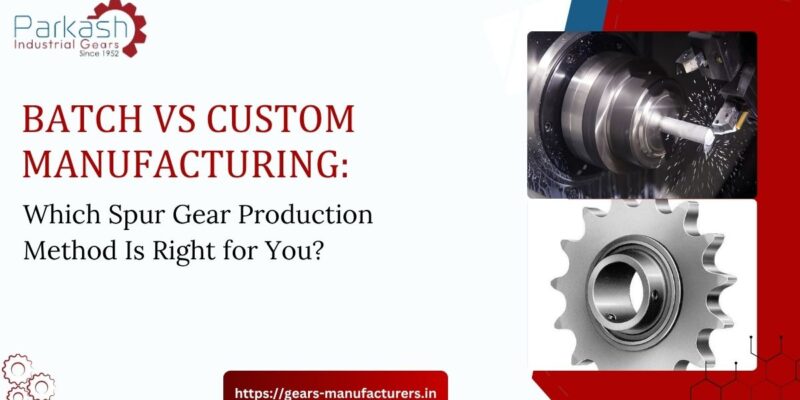
Batch vs Custom Manufacturing: Which Spur Gear Production Method Is Right for You?
Spur gears are among the most widely used components in industrial machinery, automotive applications, and heavy-duty equipment. Their straightforward design, high efficiency, and ability to transmit power between parallel shafts make them indispensable in countless industries. However, one critical decision businesses must make when sourcing spur gear is choosing between batch manufacturing and custom manufacturing.
As a leading spur gear manufacturer and one of the most recognized gears manufacturers in India, Parkash Industrial Gears has seen how this decision directly affects cost, lead time, and application-specific performance. This blog explores both methods in detail, helping you choose the right approach for your requirements.
Understanding Spur Gear Manufacturing
Before comparing batch and custom manufacturing, it’s essential to understand spur gear production itself. Spur gears are created by cutting gear teeth into cylindrical blanks using precision machining processes such as hobbing or shaping. The accuracy of these teeth, their material, and finishing determine how well the gear performs under load and at different speeds.
Manufacturers typically categorize production into two main approaches: batch production (gears made in standard sizes and volumes) and custom production (gears tailored to unique specifications).
What is Batch Manufacturing?
Batch manufacturing involves producing spur gears in standardized sizes and specifications in predetermined quantities. These gears are stored in inventory and distributed to clients based on demand.
Advantages of Batch Manufacturing:
- Cost-Effectiveness at Scale
Producing gears in batches reduces manufacturing costs per unit. This is ideal for industries that need large quantities of standard gears. - Shorter Lead Times
Since batch-manufactured gears are often ready in stock, delivery times are significantly shorter, helping companies maintain quick turnaround for their equipment. - Proven Reliability
Standardized designs have been tested and refined over time, ensuring dependable performance in most general applications.
Limitations of Batch Manufacturing:
- Lack of Customization: Standard gears may not fit specialized machinery, leading to compromises in performance.
- Inventory Costs: Maintaining stock requires storage space and capital.
- Design Restrictions: Innovation is limited to pre-defined designs, which may not align with modern or emerging applications.
What is Custom Manufacturing?
Custom manufacturing caters to clients with specific gear requirements that standard options cannot meet. It involves designing and producing spur gears tailored to exact specifications, including dimensions, materials, and tolerances.
Advantages of Custom Manufacturing:
- Tailored Solutions
Custom gears are designed to integrate seamlessly with unique machinery, ensuring better performance and longer service life. - Material Flexibility
Clients can select materials based on load, environment, and operational conditions, enhancing durability. - Optimized Efficiency
Gears can be engineered for specific speed ratios and torque requirements, improving energy efficiency and reducing wear.
Limitations of Custom Manufacturing:
- Higher Initial Costs: Designing and producing one-off gears involves more engineering effort and setup costs.
- Longer Lead Times: Customization requires additional time for design, prototyping, and production.
- Limited for High Volume: Producing large numbers of unique gears can be cost-prohibitive compared to batch production.
Key Factors to Consider When Choosing a Production Method
When deciding between batch and custom manufacturing, companies should evaluate several factors:
1. Application Requirements
If your machinery relies on standard sizes and functions, batch-manufactured gears will likely suffice. However, if your application requires precise torque, alignment, or unique load handling, custom gears may be essential.
2. Budget and Cost Structure
Batch production offers economies of scale, reducing costs per unit. On the other hand, if performance and longevity outweigh cost considerations, investing in custom manufacturing could provide better value over time.
3. Lead Time and Availability
Need gears quickly? Batch-manufactured options are typically available off-the-shelf. Custom gears, however, require design and fabrication time, which should be factored into project timelines.
4. Volume of Production
Large-scale industrial projects that use thousands of gears benefit from batch production. Specialized equipment manufacturers producing limited machines may find custom gears more suitable.
5. Long-Term Maintenance
Custom gears can simplify maintenance by ensuring perfect compatibility, whereas batch gears might require additional modifications or adjustments during replacements.
Why Partnering with the Right Spur Gear Manufacturer Matters
Whether opting for batch or custom manufacturing, the expertise of the gear manufacturer significantly influences product quality and reliability. Trusted gears manufacturers in India, like Parkash Industrial Gears, provide:
- Precision Engineering: Advanced CNC machinery and quality testing ensure gears meet exact tolerances.
- Material Expertise: From hardened steel to specialty alloys, the right material selection extends gear life.
- Consultative Support: Guidance in choosing between standard and custom options based on project needs.
- End-to-End Service: From design to production and after-sales support, a reliable manufacturer ensures seamless operations.
Batch vs Custom: Which is Right for You?
- Choose Batch Manufacturing if:
- You need large volumes of standard gears.
- Your priority is cost efficiency and quick delivery.
- Your machinery can operate with standard specifications.
- Choose Custom Manufacturing if:
- Your equipment requires unique gear dimensions or properties.
- You prioritize performance, precision, and durability over cost.
- You operate in niche industries with specialized machinery.
Many businesses benefit from a hybrid approach—using batch-manufactured gears for general components and custom solutions for specialized parts.
Conclusion
Both batch and custom manufacturing have distinct advantages and trade-offs. The right choice depends on your application, budget, and production volume. For businesses seeking a reliable partner, Parkash Industrial Gears, an experienced spur gear manufacturer and one of the leading gears manufacturers in India, offers both standardized and tailored solutions to meet diverse industry needs.
Looking for expert guidance on choosing the right gear manufacturing method? Contact Parkash Industrial Gears today and get customized solutions that drive performance and efficiency.
 FSC India.

This Post Has 0 Comments