
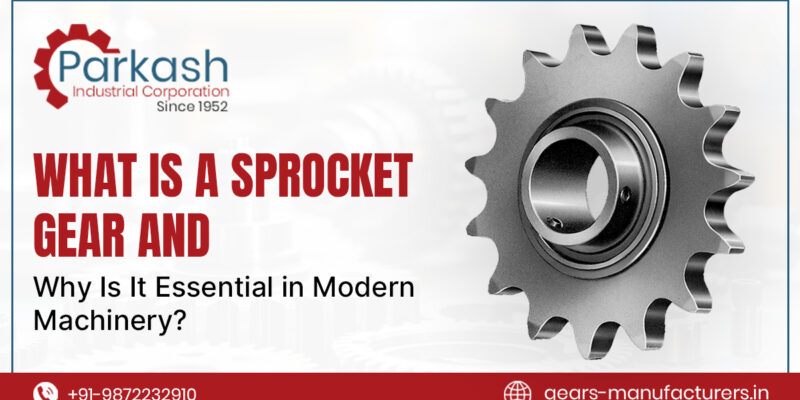
What Is a Sprocket Gear and Why Is It Essential in Modern Machinery?
If you have ever looked closely at a bicycle, a motorbike, or a factory conveyor belt, you have already seen a sprocket gear in action — you just may not have known what it was called.
A sprocket gear is a toothed wheel that meshes with a chain, track, or perforated belt to transfer motion and power from one part of a machine to another. Unlike regular gears that press against each other directly, a sprocket gear works with a chain in between. That chain-and-sprocket combination is what makes so many machines reliable, precise, and long-lasting.
Let’s break it down in plain terms.
How Does a Sprocket Gear Actually Work?
Think of the way a bicycle works. When you press the pedals, a large toothed wheel (that’s the sprocket) turns. That motion is passed on through a chain to a smaller sprocket on the rear wheel. The rear wheel spins, and the bicycle moves forward.
That same basic idea is used in hundreds of industrial machines — from printing presses and packaging lines to agricultural equipment and steel plants.
The teeth on a gear sprocket gear are what hold everything in place. They catch each link of the chain and keep it from slipping. This is why sprocket gears are trusted in heavy-duty applications where precision matters and there’s no room for error.
Types of Sprocket Gears You’ll Come Across
There is no one-size-fits-all when it comes to sprocket gears. Different machines need different types. Here are the most common ones:
1. Single Strand Sprockets
Used with a single chain. These are the most common type — found in light to medium-duty machines.
2. Double Strand Sprockets
Built for heavier loads. Two chains run side by side to share the power.
3. Idler Sprockets
These don’t drive anything. They just guide the chain and keep it tight and on track.
4. Taper Lock Sprockets
Easy to mount and remove. Very popular in industrial setups where maintenance is frequent.
5. Conveyor Sprockets
Specifically designed for conveyor systems in factories and warehouses. These handle continuous, heavy-load operation.
Each type is made for a specific job. Getting the wrong one can wear out your machine faster or cause breakdowns.
Where Are Sprocket Gears Used?
You’d be surprised how many everyday industries depend on sprocket gears. Here’s a quick look:
– Automobile industry — Engine timing systems, motorcycle drive chains
– Agriculture — Tractors, harvesters, irrigation systems
– Food processing — Conveyor lines in packaging plants
– Mining — Heavy excavation and drilling equipment
– Textile industry — Looms and spinning machines
– Steel plants — Rolling mills and material handling
– Printing industry— Paper feeding and roll-to-roll machines
Anywhere you see a chain moving something, there’s a sprocket gear making it happen.
Why Are Sprocket Gears So Important in Modern Machinery?
Here’s the honest answer — machines can’t run smoothly without them.
When power needs to travel from a motor to a moving part, something has to carry it. Belts can slip. Direct gear-to-gear contact creates heat and wear. But a sprocket gear paired with a chain? That combination gives you:
– Accurate speed control — You can change speeds just by changing sprocket sizes
– High load capacity — Handles heavy-duty applications without breaking down
– Long service life — Quality sprocket gears last for years with basic maintenance
– Low maintenance cost — Simple design means fewer things can go wrong
– Reliable torque transfer — Power moves from point A to point B without loss
In short, a good sprocket gear keeps your machine running on time, every time.
What to Look for When Buying a Sprocket Gear?
Not all sprocket gears are made equal. Here’s what matters when you’re choosing one:
Material: Most industrial sprockets are made from carbon steel, stainless steel, or cast iron. For food-grade or corrosive environments, stainless steel is the right choice.
Number of teeth: More teeth = slower speed but more torque. Fewer teeth = faster speed but less pulling power. Match this to your machine’s needs.
Pitch: This is the distance between chain links. Your sprocket pitch must match your chain pitch exactly, or they won’t work together.
Heat treatment: If your machine runs in high-temperature or high-friction conditions, look for sprockets with hardened surfaces.
Bore size: The center hole of the sprocket must fit your shaft perfectly — not too tight, not too loose.
When in doubt, always consult the manufacturer before buying.
Why Sourcing from the Right Manufacturer Matters
A sprocket gear is only as good as the steel it’s made from and the precision with which it’s cut. A poorly made sprocket will wear out faster, cause chain slippage, and ultimately stop your entire production line.
This is why companies across India trust experienced gears manufacturers for their industrial components. Quality sprocket gears are not just about meeting a size specification — they’re about consistency, durability, and performance under pressure.
At Parkash Industrial Corporation, we have spent years manufacturing high-quality sprocket gears, gear sprocket gears, and a wide range of industrial gears for sectors like automobile, agriculture, steel, textile, mining, and more. Every gear that leaves our facility is built to handle real-world demands — tight tolerances, heavy loads, and continuous operation. We don’t just make gears; we make sure they perform when it matters most.
Whether you need a standard catalogue sprocket or a custom-made gear for a specific machine, working with a manufacturer who understands your application makes all the difference.
Maintaining Your Sprocket Gear — Simple Tips
Good maintenance keeps sprocket gears running longer and saves you money in the long run. Here’s what to keep in mind:
– Lubricate regularly — A well-oiled chain reduces friction and extends the life of both the chain and the sprocket
– Check for wear — Look at the teeth. If they look hooked or pointed instead of flat, the sprocket is wearing out
– Keep tension right — A chain that’s too loose will jump; too tight and it puts strain on bearings
– Align properly — Misaligned sprockets wear unevenly and cause chain problems fast
– Replace in pairs — When you replace a chain, replace the sprocket too. A worn sprocket will quickly damage a new chain
These are small habits that prevent big repair bills.
Final Thoughts
A sprocket gear might look like a simple toothed wheel, but it plays a massive role in keeping modern machinery moving. From the vehicle you drive to the food you eat — chances are a sprocket gear was involved somewhere in that process.
If your business depends on machines, investing in quality sprocket gears isn’t optional — it’s essential. And finding the right gears manufacturers in India who can deliver consistent, well-engineered products is just as important as choosing the right gear type.
Parkash Industrial Corporation has built its reputation by doing exactly that — delivering gear solutions that industries rely on, day after day.
Whether you’re upgrading your machinery or setting up a new production line, make sure the sprocket gears you choose are built to handle the job.
 FSC India.

This Post Has 0 Comments